
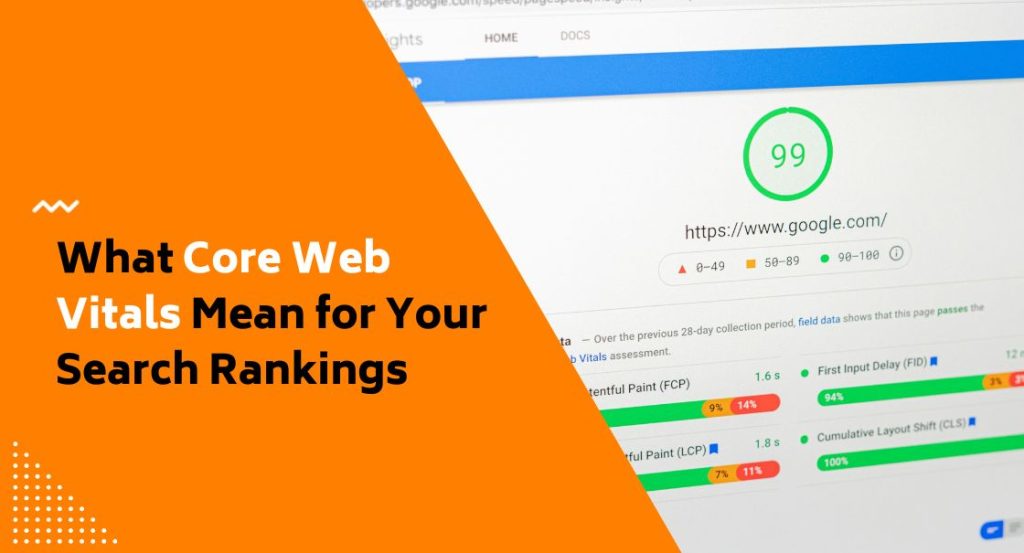
If you’ve ever opened a website, waited a beat or two for it to load, and then just… left, you’ve experienced exactly what Core Web Vitals are designed to measure. At FirstPage Marketing, we talk about these metrics with almost every client who asks why their rankings aren’t where they should be. And more often than not, page performance is part of the answer.
What Are Core Web Vitals?
Core Web Vitals are a set of specific, measurable signals Google uses to evaluate the real-world experience visitors have on your website. They don’t measure opinion or aesthetics. They measure speed, responsiveness, and visual stability: the things that determine whether a user stays on your page or bounces to a competitor’s.
There are three metrics Google focuses on:
Largest Contentful Paint (LCP)
This measures how long it takes for the main content of a page to fully render. Think of it as the moment your hero image or headline appears and the page actually feels loaded. Google wants this done in under 2.5 seconds. Anything beyond 4 seconds is considered poor.
Interaction to Next Paint (INP)
This replaced the older First Input Delay metric and gives a more complete picture of how responsive your site is during real user interactions. Every click, tap, or keypress triggers a measurement. The target is under 200 milliseconds.
Cumulative Layout Shift (CLS)
This one measures visual stability. Ever clicked a button that shifted just before your finger landed and ended up somewhere unintended? That’s a CLS problem. Google wants a score under 0.1.
How They Actually Affect Your Rankings
Core Web Vitals are a confirmed Google ranking signal. They aren’t, however, the most powerful one, and content relevance and authority still matter far more for determining where your page sits in search results.
What Core Web Vitals do function as is a tiebreaker. When two pages cover similar ground with comparable quality and backlink profiles, the one with better performance scores is more likely to rank higher. In competitive local markets, which is the reality for many Fraser Valley businesses, that tiebreaker matters.
Poor Core Web Vitals won’t crater your rankings overnight. What they will do is quietly drag on your performance over time. Slow sites accumulate higher bounce rates, shorter dwell times, and weaker engagement signals, all of which feed into how Google reads the value of your page. It becomes a compounding problem rather than a single penalty.
Find out how AI Overviews are changing click-through rates.
The Conversion Side of the Equation
This is the part we find ourselves explaining most often: Core Web Vitals affect your business results well beyond your ranking position. A site that ranks reasonably well but loads sluggishly can still lose a significant number of potential customers before they ever read a word about your services.
The connection between site speed and revenue is well-documented across industries. Companies that have focused on improving LCP performance have seen measurable lifts in sales and conversion rates. For service-based businesses where a single new client can represent thousands of dollars in revenue, even modest improvements in conversion are meaningful.
Think about it from your customer’s perspective. If your site takes four seconds to load on a mobile phone with a decent connection, a good portion of visitors will leave before they see what you do. They’re not judging your services at that point. They never got that far.
What Causes Poor Core Web Vitals?
We see the same culprits come up repeatedly when we dig into a site’s performance. Understanding what drags scores down is the first step toward fixing them:
- Large, uncompressed images: A high-resolution photo that hasn’t been optimized for web can add seconds to your load time on its own. This is among the most common LCP killers we encounter.
- Render-blocking scripts and stylesheets: JavaScript and CSS files that load before your content can delay when the page becomes usable, pushing INP scores higher.
- No defined image or embed dimensions: When the browser doesn’t know how much space an element will take up, content shifts as the page loads. This is the primary driver of CLS issues.
- Slow server response times: Sometimes the problem starts before any content even begins to load. Sluggish hosting can add meaningful delay right at the start.
- Too many third-party scripts: Chat widgets, analytics tools, social media embeds, every one adds loading overhead, and they start competing for resources quickly.
Mobile Performance Is Non-Negotiable
Google uses mobile-first indexing, which means your mobile Core Web Vitals scores are the ones that count for rankings. Your desktop scores don’t drive the evaluation. If your site loads beautifully on a desktop but struggles on a phone with a typical mobile connection, that’s the version Google is assessing.
This fundamentally changes how you need to think about performance. A site that looks perfect on a laptop but scores poorly on mobile is leaving ranking potential on the table every single day, and we see this more often than you’d expect.
Where to Focus Your Improvement Efforts
If your scores need work, we generally recommend starting with the changes that have the highest impact for the least complexity:
- Compress and properly size images, and consider switching to next-generation formats like WebP
- Set explicit width and height attributes on images and embeds to prevent layout shifts
- Reduce the number of third-party scripts on your pages, or defer them to load after your main content
- Make sure your hosting environment is configured for performance, not just uptime
- Implement browser caching so returning visitors load your pages faster
Getting from “Poor” to “Good” on any metric typically has a noticeable effect on both rankings and user experience. Getting from “Good” to “Excellent” brings real performance improvements, but the incremental ranking benefit is marginal. Fix the serious problems first, and don’t get lost chasing perfection on scores that are already solid.
The Bigger Picture
Core Web Vitals are one piece of a broader SEO strategy. A fast-loading site with thin, irrelevant content is not going to outrank a slower site with genuinely useful, authoritative pages. Content quality and topical relevance are still doing the heavy lifting.
The way we think about it: you want every factor working in your favour. Strong content and a fast, stable website aren’t competing priorities. They reinforce each other. Core Web Vitals can be the differentiator when everything else in your strategy is already solid.
At FirstPage Marketing, improving page performance is part of how we approach SEO for our clients. If your site’s Core Web Vitals scores are holding back your rankings or quietly costing you conversions, we’d be happy to take a look. Give us a call at 604-866-2230 and let’s figure out where the opportunities are.