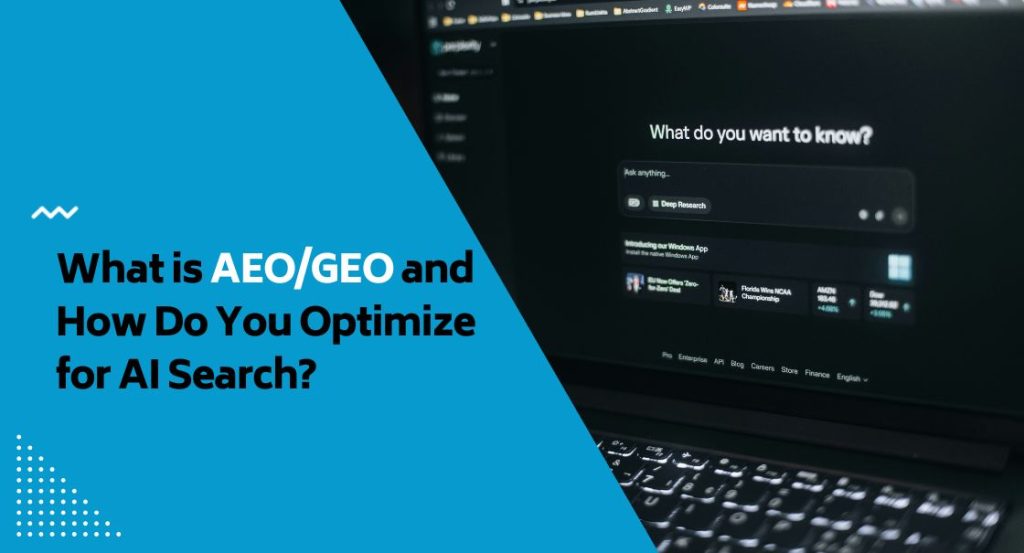
Type a question into ChatGPT these days and you’ll get a full answer, not a page of blue links to click through. That shift is why more business owners are asking us about answer engine optimization (AEO) and generative engine optimization (GEO), and whether they need a plan for showing up in AI-generated answers instead of just Google’s search results. At FirstPage Marketing, we field this question daily now, so let’s break down what AEO/GEO actually means and how you optimize for AI search without starting from scratch.
What Do AEO and GEO Actually Mean?
Answer engine optimization (AEO) is the practice of shaping your content so AI tools like ChatGPT, Google AI Overviews, Perplexity, and Copilot can find it, understand it, and use it to build a direct answer for whoever asked the question. We think of generative engine optimization (GEO) as covering similar territory: structuring your content and managing your online presence so large language models retrieve, interpret, summarize, and present your business favourably when someone asks about your industry in that space.
Here’s the part that trips up a lot of business owners: most companies in this space, us included, now treat AEO and GEO as one connected discipline rather than two separate services. Some practitioners still draw a technical line, using AEO for older concepts like featured snippets and voice search results, and GEO specifically for chat platforms. In practice, the goals overlap so much that the distinction rarely changes what you’d actually do to improve your visibility.
Learn how to use customer personas to guide marketing decisions.
How This Differs from Traditional SEO
Traditional SEO, the way we’ve always practiced it, earns you a ranked spot on a results page. AEO and GEO earn you something different: a mention, or ideally a direct citation, inside an answer the person never has to click away from. That’s a fundamentally different job, and it changes several things at once:
- Query style shifts: People type short keyword phrases into Google, but they ask full conversational questions in ChatGPT or Perplexity.
- Output format shifts: Instead of a ranked list of links, the AI produces one synthesized answer that pulls from several sources at once.
- Success metrics shift: Rankings and click-through rate matter less than mentions, citations, share of voice, and AI-referral traffic across the platforms people actually use.
- The core mechanism shifts: Backlinks and domain authority still count, but entity clarity, structured content, schema markup, and source credibility carry a lot more weight in how an AI decides who to quote.
None of this replaces the SEO work you’ve already invested in with us. It builds on top of it.
Why This Matters More Than It Might Seem
We get it: AI platforms still send a small fraction of the direct traffic that Google does. But the businesses paying attention to this early are protecting against a different kind of risk, one that has less to do with website visits and more to do with disappearing from the conversation entirely.
Research into how B2B buyers actually research vendors backs up a pattern we see constantly in our own client conversations: a striking number of companies are effectively invisible during the earliest stage of AI-driven research, only showing up in an AI’s answer once a buyer already knows the company by name. We’ve started calling this the inverted discovery funnel. Instead of an AI introducing your business to new buyers, it only recognizes you after someone else already has, which means the businesses missing from that first conversation are losing out before a prospect ever visits their site.
When we run visibility scans for clients, a consistent pattern turns up: pages missing structured data, thin or generic meta descriptions, page titles that don’t clearly signal what the content is about, and content that hasn’t been refreshed in years. Those are exactly the signals AI systems lean on to understand a page and decide whether it belongs in an answer. A site can look perfectly healthy from a traditional technical SEO standpoint and still fail to earn AI visibility, because the two aren’t measuring the same thing.
How to Actually Optimize for AI Search
This is where AEO/GEO gets practical. Here’s what we focus on when we’re setting a business up for stronger AI visibility:
- Technical accessibility: make sure AI crawlers like GPTBot, ClaudeBot, PerplexityBot, and Google-Extended can actually access and parse your site, alongside solid site architecture and quick load times.
- Structured data and schema markup: implement Local Business, FAQ, HowTo, Article, and Product schema so AI systems can label and extract your content accurately instead of guessing at it.
- Content built for extraction: rewrite dense pages into clear summaries, FAQs, comparison points, and answer-ready sections an AI can lift cleanly instead of having to interpret.
- Entity and authority building: earn mentions and citations from industry publications, review platforms, comparison pages, and other trusted sources that AI systems draw on when deciding who to trust in your category.
- Review and reputation management: keep your Google Business Profile and other review platforms current, since AI models weight recent, credible reviews heavily when making local and commercial recommendations.
Content Structure Still Comes First
No amount of schema markup will save content that doesn’t actually answer the question someone asked, and that’s the first thing we tell clients. Before you touch a technical checklist, make sure each page leads with a clear, direct answer near the top, then backs it up with the kind of specific detail a generic competitor page wouldn’t bother including. AI systems are built to extract clarity, so give them content that’s clear and specific rather than padded out to hit a word count.
A Few Misconceptions Worth Clearing Up
AI search isn’t going to erase your website traffic overnight, whatever the worry floating around suggests. We hear this concern constantly, and it’s usually pointed at the wrong thing. Traditional search still sends the overwhelming share of referral traffic compared to AI chat platforms combined, and Google itself remains the dominant source of search traffic, even as AI Overviews show up on a growing share of everyday queries.
Find out how AI overviews are changing click-through rates.
The mindset shift we encourage clients to make is this: being mentioned by an AI system, even without a link back to your site, is its own kind of marketing. Buyers researching options through ChatGPT or Perplexity are forming an opinion about who the credible options are before they ever land on a website. If your business isn’t part of that conversation, someone else’s is, and they’re earning the trust that should have been yours.
Getting Started
AEO and GEO aren’t a replacement for your SEO strategy. They’re an extension of it, built for how people are starting to search. The businesses that treat AI visibility as an afterthought are the ones showing up invisible in the exact research that used to bring them new customers. If you’re ready to find out where your business stands and build a plan to close the gaps, we can walk you through it. Give us a call at 604-866-2230, and let’s get your business into the conversation AI is already having about your industry.