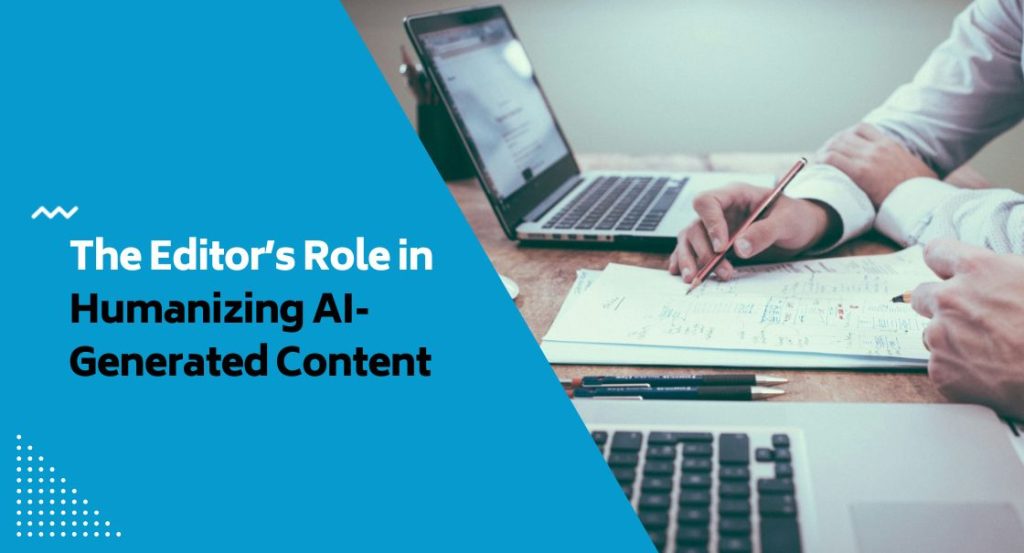
AI writing tools can produce a 1,200-word blog post in under a minute. That’s impressive, no question. But impressive output and useful output aren’t the same thing. At FirstPage Marketing, we’ve spent a lot of time thinking about where AI fits into a content workflow and what happens when it’s left to run unsupervised. The short answer: the content reads like it was written by someone who has never actually talked to a customer.
That’s where editing comes in. Not light proofreading. Real, substantive editing that takes AI-generated content and makes it sound like it was written by a person who knows your business, your audience, and what they actually care about.
Why AI Content Falls Flat
AI language models are trained to produce text that is statistically coherent. They’re very good at this. What they’re not good at is understanding nuance, brand voice, or the specific motivations of your customers.
The problems tend to cluster in predictable places:
- Generic phrasing. AI defaults to language that technically applies to every business and therefore resonates with none of them.
- Passive authority. There’s a lot of stating facts without a clear point of view: informative, but unconvincing.
- Structural predictability. Paragraphs often follow identical rhythms, which dulls the reading experience quickly.
- Missing specificity. The content covers topics without committing to a clear position on them.
None of these are dealbreakers on their own. Together, they produce content that is technically correct and completely forgettable.
Learn how to write better content for different platforms.
What an Editor Actually Does
Editing AI content is different from editing human-written content. With a human writer, you’re refining an existing voice. With AI, you’re often installing one from scratch.
Establishing a Point of View
AI is calibrated to avoid controversy, which sounds reasonable until you realize it also avoids conviction. Readers trust content that takes a clear stance, and one of the most valuable things we do as editors is identify where the AI hedged unnecessarily and replace vague language with a confident, specific perspective.
This means cutting the qualifiers and letting the content say what it actually means. “Search engine optimization can be an important part of a digital marketing strategy” becomes “If you want people to find your business online, SEO is non-negotiable.”
Injecting Audience Awareness
Good content speaks directly to the person reading it. AI often speaks at readers instead. We bridge that gap by asking a simple question throughout the piece: does this paragraph address something the reader actually cares about?
If a paragraph on web design best practices spends several sentences explaining what responsive design is without ever connecting it to the reader’s business, it needs to be rewritten. The definition isn’t the point. The consequence, that your website alienates mobile visitors before they’ve seen your products, is the point.
Fixing Voice and Tone
Every business has a voice, whether they’ve articulated it or not. It lives in the way your team talks to customers and in the language you reach for when describing what you do. AI doesn’t have access to any of that.
Our job as editors is to translate AI output into the company’s actual voice. For a formal professional services firm, that might mean tightening language and removing conversational asides. For a company like ours, it means loosening things up: using contractions, asking rhetorical questions, letting a bit of personality through. Neither approach is right for everyone, but both require a human to make the call.
Restructuring for Readability
AI tends to over-explain and under-organize. It will sometimes bury the most useful insight in the third paragraph of a four-paragraph section, or front-load so much context that readers disengage before reaching the actual point.
Editors restructure. We move paragraphs, split sections, and cut what’s redundant.
The Risks of Skipping the Edit
Publishing unedited AI content carries real risks for your brand.
Readers notice when content sounds off. They may not be able to articulate exactly why, but they sense the absence of a real perspective. That disconnect erodes trust, which is the exact opposite of what your content is supposed to accomplish.
There’s also the accuracy problem. AI draws on broad training data and sometimes mischaracterizes specifics: industry regulations, local market conditions, details about your services that aren’t publicly documented. An editor who knows the business catches these before they go live. A business that skips the edit publishes them.
Search engines are getting increasingly good at evaluating content quality in terms of helpfulness and relevance to real readers. Content that reads as generic and non-committal tends to underperform, regardless of how technically well-structured it is.
Learn all about the importance of creating problem solving content.
A Practical Editing Framework
If you’re incorporating AI into your content process, here’s how to approach the editing stage in a way that actually transforms the output.
Read the Full Draft Before Touching Anything
Get a sense of what the AI produced holistically. Note the sections that need the most work rather than line-editing from the top.
Identify the Core Argument of Each Section
If you can’t summarize what a paragraph is trying to say in one sentence, the paragraph needs to be rewritten. AI content often lacks a controlling idea, and that’s exactly what a good editor adds.
Replace Abstract Language with Concrete Examples
Every time you see a vague claim, ask yourself what a specific example looks like. “Businesses benefit from a consistent content strategy” becomes a lot more useful with an actual illustration of what that looks like for a local service provider.
Read It Out Loud Before Finalizing
This sounds simple, but it works. If you stumble over a sentence while reading it aloud, so will your readers. Awkward AI phrasing that looks fine on screen tends to reveal itself the moment you say it out loud.
AI Is a Starting Point, Not a Shortcut
At FirstPage Marketing, we use AI tools in our content process. We also spend meaningful time editing what they produce, because the combination is what makes it worthwhile. AI removes a lot of the blank-page friction, and human editing ensures the final product sounds like us and actually serves the people reading it.
The mistake businesses make is treating AI generation as the end of the workflow. It’s the beginning. The editing is where the content goes from technically adequate to actually worth reading, and that distinction matters enormously for your brand and your search rankings.
If you’re not sure whether your content is working as hard as it should, we’d love to talk. Reach out to our team at 604-866-2230.