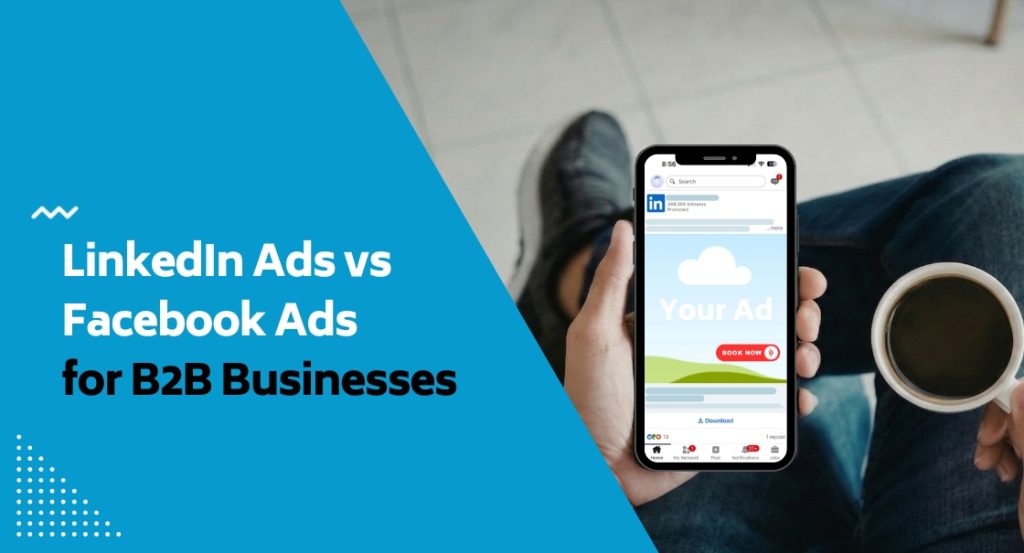
If you run a B2B company and you’re trying to figure out where your ad budget should go, the LinkedIn vs. Facebook question comes up sooner or later. At FirstPage Marketing, we work through this decision with clients regularly, and the honest answer is that it depends on a few key factors specific to your business. Understanding how LinkedIn Ads and Facebook Ads work for B2B businesses, and where each one falls short, makes that decision a lot easier.
Find out if using Google Performance Max campaigns are the right choice for your business.
The Core Difference: Audience Mindset
The most important thing to understand about these two platforms isn’t cost or targeting, although both matter. It’s context. When someone opens LinkedIn, they’re in professional mode. They’re thinking about their work, their industry, their career. An ad for a B2B software solution or a commercial service fits naturally into that environment.
Facebook is different. People scroll through it to relax, see what friends are doing, and catch up on news. That doesn’t mean B2B advertising can’t work there, but it means you’re interrupting a casual experience rather than meeting someone where they’re already thinking about business problems. That shift in mindset has real implications for how people respond to your ads.
Learn how to create successful retargeting campaigns.
LinkedIn Ads: Precision Targeting for Decision-Makers
LinkedIn’s biggest advantage for B2B is its targeting. No other social platform lets you filter your audience based on professional criteria pulled directly from user profiles. That data is self-reported and reasonably accurate, which makes it genuinely useful in a way that interest-based targeting on other platforms isn’t. The targeting options include:
- Job title and job function
- Seniority level
- Company size and specific company names
- Industry
- Professional skills and member groups
For account-based marketing or any campaign aimed at reaching specific decision-makers, it’s hard to replicate that precision elsewhere.
The lead quality difference is consistently significant. LinkedIn’s visitor-to-lead conversion rate meaningfully outperforms Facebook for B2B, and those leads tend to progress through the sales funnel at a higher rate. The underlying reason is intent: someone engaging with a sponsored post on LinkedIn is more likely to be actively thinking about business problems than someone who clicks an ad while scrolling through their personal feed.
What LinkedIn Ads Work Best For
LinkedIn tends to perform best when:
- Your target audience is defined by professional criteria (job title, industry, company size)
- You’re selling high-value services or products where the longer sales cycle justifies higher acquisition costs
- You want to reach senior decision-makers who are hard to isolate on other platforms
- You’re running an account-based marketing strategy targeting specific companies
- Thought leadership content is part of your marketing mix
The Cost Reality
LinkedIn advertising is noticeably more expensive than Facebook. Cost per click is significantly higher, and the platform requires a real budget commitment to generate enough data to optimize against. Underfunded LinkedIn campaigns tend to produce inconclusive results rather than useful learning, so if you’re going to test it, give it a real chance.
The higher cost per click stings at first glance. But the relevant comparison isn’t cost per click or even cost per lead. It’s cost per sales-qualified opportunity. When LinkedIn leads convert at a higher rate and close at higher deal values, the economics often work out in LinkedIn’s favour, particularly for B2B services with longer sales cycles and enterprise-level contracts.
Facebook Ads: Reach, Retargeting, and Lower-Funnel Efficiency
Writing off Facebook for B2B is a mistake. With a large and active user base across Canada and sophisticated interest and behaviour-based targeting, Facebook offers reach that LinkedIn simply can’t match. The platform also gives you access to Lookalike Audiences, which can be remarkably effective for B2B when you’re working from a strong seed audience of existing customers or website visitors.
Where Facebook genuinely struggles for B2B is professional targeting accuracy. LinkedIn users update their profiles regularly because it’s tied to their career. Facebook users often don’t update job titles or employers, which means targeting by professional criteria is far less reliable. You can layer interest targeting and employer data to approximate your ideal audience, but it’s a workaround rather than a precision tool.
Where Facebook Earns Its Place in B2B Campaigns
Facebook tends to deliver the strongest returns for B2B when used for:
- Top-of-funnel awareness campaigns where broad reach matters more than precise targeting
- Retargeting website visitors and warm audiences (Facebook’s minimum retargeting audience threshold is much lower than LinkedIn’s, making it more practical for smaller websites)
- Testing messaging and creative at lower cost before scaling on LinkedIn
- B2B products or services with shorter sales cycles and lower deal values, where Facebook’s lower cost per click translates to more efficient acquisition
- Campaigns targeting small business owners, who tend to be active on Facebook in personal and professional contexts simultaneously
We often recommend this sequencing to clients who are working with tighter budgets: start on Facebook to refine your messaging and understand which creative resonates, then move that validated content to LinkedIn to reach higher-value prospects. Testing your angles at lower cost before scaling makes a real difference to how efficiently your LinkedIn spend performs.
The ROI Question Is More Complicated Than It Looks
One of the genuine challenges with B2B advertising attribution is that the sales cycle is long. A prospect might first encounter your brand through a LinkedIn ad, spend weeks or months in the consideration phase, and eventually convert through a Google search or a direct visit. If your attribution window is set to 30 or 60 days, that original LinkedIn touchpoint never gets credited, even though it started the whole process.
Why Facebook Often Gets Too Much Credit
This creates a common distortion in B2B reporting: Facebook looks like it’s performing better because its lower-funnel retargeting converts faster and those conversions are easier to attribute. LinkedIn’s contribution often happens earlier in the buying process, where a decision-maker first becomes aware of your company or starts comparing options. That influence is real, but it’s harder to see in a standard analytics report.
The metric that matters is cost per sales-qualified opportunity, not cost per lead. The gap between those two numbers is large in B2B, and optimizing for the wrong one leads to budget decisions that look good on paper but underperform in actual revenue. When we work through attribution with clients, shifting that reporting lens is often the first thing that changes how they see their campaigns.
A Few Things Canadian B2B Advertisers Should Know
If your business serves Canadian clients, there are a couple of things worth knowing before you commit your ad budget to either platform.
Privacy Regulations Are Evolving
Canada’s federal privacy framework under PIPEDA applies to how platforms collect and use targeting data, and the Office of the Privacy Commissioner has ruled that certain offline conversion integrations with Meta require opt-in consent. Quebec’s Law 25 goes further, introducing GDPR-style requirements that affect any advertiser with an audience in the province. If you’re running campaigns that touch Quebec, your data collection and consent mechanisms need to reflect that.
Federal privacy reform legislation has stalled following the prorogation of Parliament, and the direction of any new bill remains uncertain. PIPEDA remains the federal baseline for now, but the direction of travel toward stronger consent requirements is clear. Building campaigns that rely on transparent data practices rather than technical workarounds is the safer long-term approach.
The Digital Services Tax Affects Your Costs
Canada’s Digital Services Tax applies to major platforms, including Meta and LinkedIn, and both companies are expected to pass some or all of these costs on to Canadian advertisers. When calculating your expected return on ad spend for Canadian B2B campaigns, factor in the likelihood that your effective platform costs will be modestly higher than global benchmark figures suggest.
Should You Use Both Platforms Together?
For most B2B advertisers with sufficient budget, the answer is yes. The platforms serve different parts of the funnel effectively, and using them together creates a more complete coverage of how your buyers actually make decisions.
A practical full-funnel approach uses Facebook for broad awareness and retargeting at lower cost, while LinkedIn handles mid-funnel lead generation where professional targeting and buyer intent are most valuable. Someone who first sees your brand in a Facebook awareness campaign and later searches your company name on LinkedIn is a warmer prospect than a cold LinkedIn target, even if the LinkedIn campaign gets the attribution credit.
That said, spreading a limited budget across both platforms too thinly rarely works. LinkedIn in particular needs a meaningful budget to generate enough data to optimize against. If your paid social budget is on the smaller side, it’s usually more effective to focus on one platform until you’ve built up enough performance data to justify expanding.
Finding the Right Platform Fit for Your Business
LinkedIn and Facebook each bring real value to B2B advertising, and the better question isn’t which platform is objectively superior but which one fits your audience, budget, and sales process right now. High-ticket B2B services selling to identifiable decision-makers at named companies tend to get more from LinkedIn. Lower-cost products with broader audiences and shorter sales cycles often find Facebook more efficient. Most established B2B advertisers eventually find a place for both.
At FirstPage Marketing, we’ve helped Fraser Valley businesses and clients across Canada build paid social strategies that actually reflect how their buyers make decisions. If you want a clearer picture of where your ad budget will do the most work, we’d love to talk it through. Give us a call at (604) 866-2230.